Posts

DANCE - The Trinity as a Model for Community

Image
I am a terrible dancer; literally. My signature move is called the ‘crazy octopus’. I invented it. But I love dancing, especially when no one is looking. I have always wanted to take dancing lessons, so that I can look better on the dance floor, but also because dancing with someone is such a beautiful thing to behold. In the ancient Orthodox tradition, the Trinity is viewed as a dance. The son moves around the father and spirit, the spirit moves around the father and son, and the father moves around the spirit and son. Each one complementing the other, each one equal. The dance itself breathing life into creation. We are called to join in this dance with God, to move in rhythm with Her. I guess that this is what they call discipleship, what they call ‘being the church’. When I think of the dance, what kind of music are we dancing to? What do the steps look like? I imagine it has to start with love, seeing as God is love. The scriptures paint the picture: Justice, mercy, peace,...

SACRIFICE - A Lenten Reflection

Image
I both love and hate lent. I hate giving up stuff; hate that I cant do whatever I want. I love all that it stands for. I love the way that it challenges our hedonistic consumerist mindset and creates a space for something that we rarely do: sacrifice . For me, Christ is the greatest example of sacrifice .  He laid down his life for us. He didn't want to, He didn't have to, He chose to.  As His disciples, we are also called to a life of sacrifice, to walk along the narrow, difficult path. One thing that you learn in life is that some people choose a life of sacrifice, whilst others have sacrifice thrust upon them . This can happen through sickness, experiences, circumstance and many other ways.  The picture that is painted of God in the scriptures is one of a God who comes along side us, comforts us, cares for us.  The same is called for us as the Church.  We are called to walk alongside those who are already ...

The Liturgical Year

Image
I have just read the liturgical Year by Joan Chittister, which was given to me as a free book by book sneeze. This book gives an introduction to the liturgical year and then gives a chapter about each aspect of the liturgical year. The liturgical year has been a very interesting book for me. Growing up in the evangelical church the only parts of the liturgical year that we follow is Christmas and Easter (and probably only because we get presents and chocolate). So I have read this book once through in a short amount of time and am now reading it through again as I go through the liturgical year. I think that this book a) presumes that you go to a church that follows the liturgical year (i.e. uses the colours of the liturgical year and changes the décor of the church accordingly, and also uses the liturgical readings) and b) presumes that you already have a basic knowledge of the liturgical year. Therefore I feel that this book is written more towards people who are already eng...

Fasting

Image
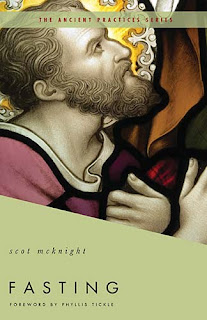
So I've just signed up for this website: booksneeze.com, you get a free boo‏k as long as you write a review of it on your blog. I chose a book on fasting. This was for several reasons: firstly because I had heard of the series already and was excited to see Phyllis Tickle as the general editor of the series, I have a lot of time for her as she has a lot of time for others, she is also viewed as an authority on ancient spiritual practices with many years of experience. She has also taken an avid interest in the emerging church, of which I have also, hence Brian Mclaren writing the first book of the series, and her friendship with Tony Jones (Tony started emergent village with Doug Pagitt and Brian mclaren and has authored several books including 'the sacred way, spiritual practices for everyday life' ) Secondly, I was excited to see that the book was written by Scot McKnight, a new testament scholar with interest in the quest for the historical Jesus and also a friend of the...

Gardener Over Mechanic - The Conversation of our Community Part 4

Image
Discipleship: in the Church we so often mistake the accumulation of knowledge, perhaps of God or of the Bible, for the journey that each person takes on their walk with God. We presume that that this growth takes place at the cross, as if we emerge like butterflies from a cocoon, transformed. Or as if a car taken into a mechanic, it goes in broken and comes out the next day fixed. There may be a few wrinkles, but the big things: addiction, self-harm, violence, circumstances, lust, greed, hatred, major personal flaws disappear. At least on the surface that’s what we see. From the teachings of Jesus we can see that our faith walk is not in the form a quick fix solution. His examples are in the form of a farmer, a tree, a vine, a vineyard, a field, or a path. These illustrations are things that take time; it takes time to grow a plant, to sow a field or to walk a path. By presenting a mechanic like approach to church life we remove the elements of grace and patience...

Poets Over Salesmen - The Conversation of our Community Part 3

Image
For the longest amount of time within the Evangelical church it feels as though our lives have been like a shop window, and God is the product. As if we are the salesmen, and God is what we are selling. The promise of triumph over illness and victory over financial problems is the sales pitch. No sign of weakness can be seen in our product or people will not buy. But what happens when this is not our default position, when life is not going our way, when we are ill, when finances are hard? Are we less of a witness for God? A poet paints a beautiful picture with their words, but the picture itself is not different from the picture seen by others, it is just that the poet sees it in a different way. The poems are honest and authentic. The poets own experiences and emotions pour through the words and create something beautiful, even out of tragedy. As a community of hope we need to be honest and authentic. To allow our experience with God and each other to tel...

Artwork Over Mechanisms - The Conversation of our Community Part 2

Image
Since the age of science began mankind has had an obsession with the way the planet works: the carbon cycle, the planets cycle, cause and effect; to the extent that to all intents and purposes we live in a ‘mechanistic universe’. The universe works like a mechanism, a huge machine. As humans we are often not as good at compartmentalization as we think we are, we transfer our models into other spheres of our life. We see humans as mechanisms, people for a purpose. The problem is that when a mechanism breaks, it no longer has any value, a broken watch is no longer useful. As human’s we put our value in so many things, when these are stripped away we lose any sense of self-value, because we no longer have a purpose. We are not mechanisms; we are creations. Gen 1.27 ‘So God created humans in his image. In the image of God he created them. He created them male and female.’ Artwork is priceless. It is the artist who gives the painting it’s value. Vincent Van Gogh’s pa...

Subscribe

* indicates required